

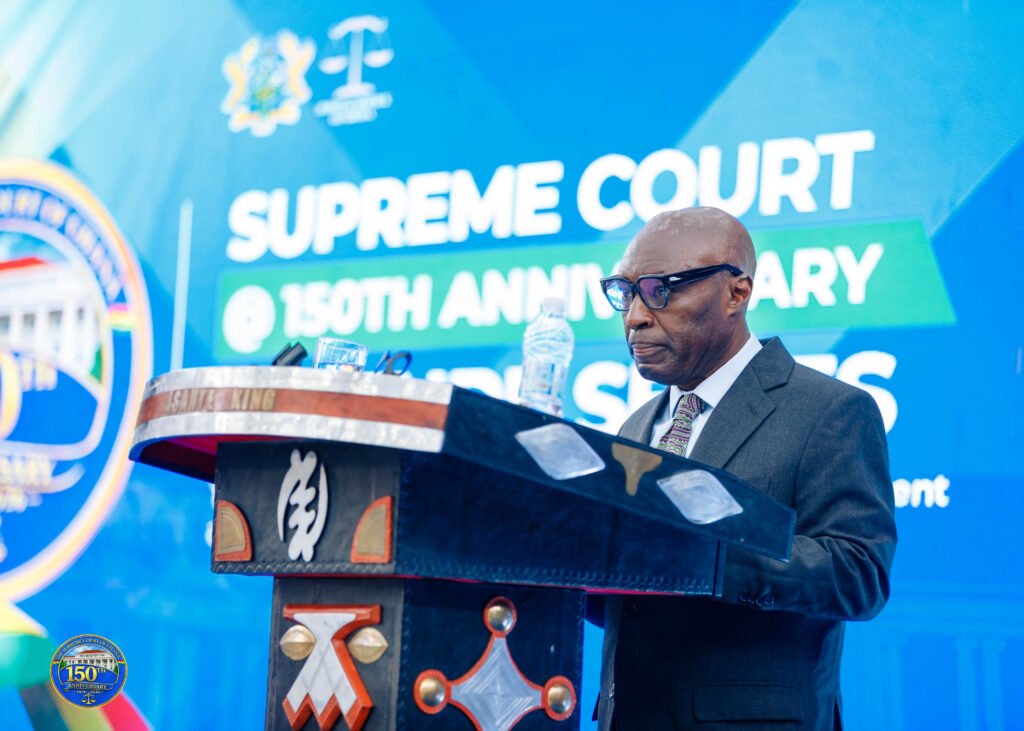

Supreme Court @150: the Full Keynote Address on “The Supreme Court and the Institution of Chieftaincy – Past, Present and the Future”
The matter with keynote addresses or lectures is that you don’t get to be asked questions. In rare cases when questions are asked, there are outlets for escape. Not being a lawyer, an academic in the discipline or a jurist, I made such known when the invitation from the Supreme Court came. I was informed that I was invited as a contemporary historian—not in the sense of legal history, but nonetheless within the broader matrix of the social sciences. It is in this understanding that I find both my confession and my comfort in standing before you.
We have come to know of two strands of history: Islamic history and ethos, which had been inspired by our pre-Gold Coast connections with the Sahel and other geographic regions, and Western or Christian historiography. The latter has been our fodder of knowledge; our varying trainings are connected to this. It could, in your case, be from the ancient learned discipline of philosophy and its evolution: the Greek philosophers who came before Marcus Cicero, Marcus Aurelius [Ori-lies] and others of the classical regime. The continuation was through imperial and empire days. The ultimate colonial heritage of modern law is about rules and regulations that order the desired behaviors we strived for in social relations that fell on us in another way.
Societies existed long before formal legal systems, and from the beginning of human community, we understood norms and obligations within our own geographic spaces well before Ghanaian modernity or the last century of state formation. From the Akan forest states through the Savannah into the Sahel, and back across the coastal belt from Keta through Accra to Axim, our peoples lived by laws rooted in custom, memory and social order. There were European merchants and trade envoys all the way: the Portuguese, the Dutch, the Danes, the French and, of course, the English, who built and inherited from among themselves in the 1400s the monuments of today.
European trade laws were imposed in colonies all over from the metropolitan capital and later, more imposition was done on our ancestors who went abroad to study. For decades, those impositions became aspirational post-colonial experiences and were formalized as progressive and enlightened norms.
Yet the very year they established a structure resembling a Supreme Court—1876, exactly 150 years ago—was at a period in which territories that would later be assembled as the Gold Coast were actively resisting British ordinances, trade regulations, and land-acquisition policies. Indeed, there was strong contestation regarding customary laws and traditions, whether late in the Northern Territories in 1901 or earlier in the southern areas of the Akan states and the coastal regions. So, these reflections would be snippets of historical recollections.
Read the full speech