

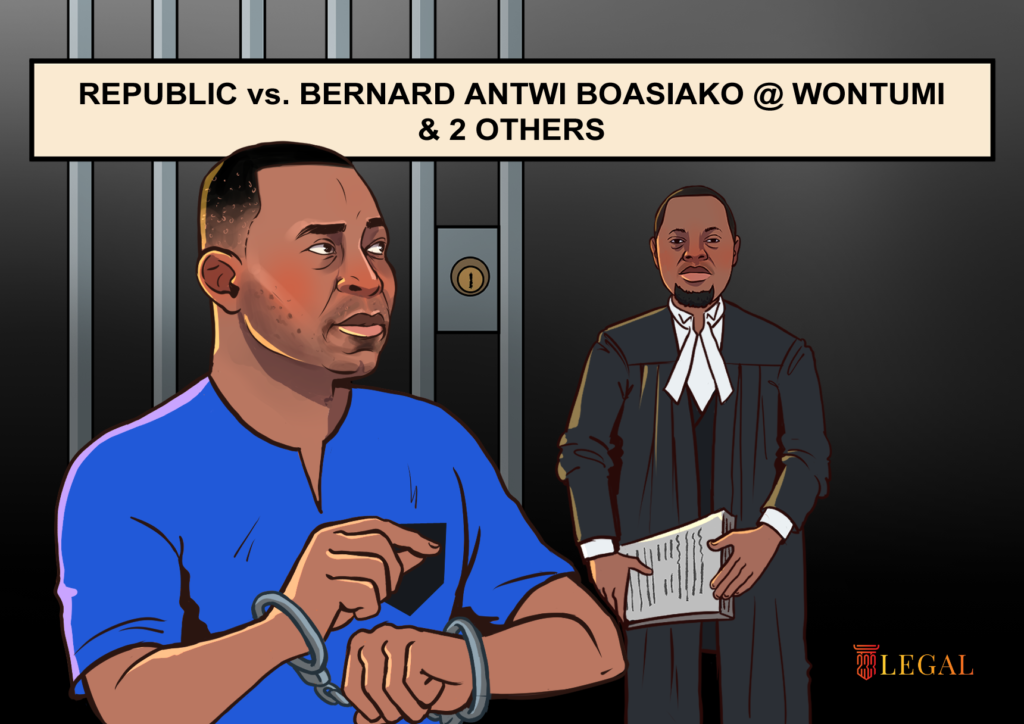

High Court (Criminal Division), Case No. CR/0004/2026 | Judgment delivered on 20 July 2026
Introduction
Can the holder of a mining lease lawfully permit another person to undertake mining activities within its concession without first obtaining the Minister’s prior written approval?
This significant decision of the High Court answered that question in the negative. In doing so, the Court clarified the meaning of “otherwise encumbered” under section 14(1) of the Minerals and Mining Act, 2006 (Act 703), explained when the corporate veil may be lifted in criminal proceedings, and reaffirmed that not every constitutional argument raised in criminal proceedings warrants a reference to the Supreme Court under Article 130 of the 1992 Constitution.
Facts:
The Republic charged Bernard Antwi Boasiako (also known as Wontumi), Kwame Antwi (who remained at large), and Akonta Mining Company Limited with six offences arising out of mining activities undertaken within Akonta Mining Company’s mining concession at Samreboi in the Western Region.
The prosecution alleged that the 1st Accused, as the controlling mind of Akonta Mining Company Limited, permitted Henry Okum and Michael Gyadu Ayisi to undertake mining operations within the company’s concession without first obtaining the Minister’s prior written approval, contrary to section 14(1) of Act 703. It further alleged that the accused persons purposely facilitated an unlicensed mining operation contrary to section 99(2)(b) of the Act.
The prosecution’s evidence was that Henry Okum entered the concession with the permission of the 1st Accused and undertook mining activities while carrying out reclamation works. During investigations, Henry Okum stated that he had reached an arrangement with the 1st Accused permitting him to mine within the concession because he understood the concession belonged to the 1st Accused.
The defence admitted that Henry Okum had been permitted to enter the concession but maintained that the permission was limited solely to land reclamation by planting coconut seedlings and did not authorise any mining activity. The defence also argued that no assignment or transfer of the mineral right had occurred and therefore sought a reference to the Supreme Court on constitutional questions relating to sections 14(1) and 99(2)(b) of Act 703.
Issues for Determination
The Court considered the following issues:
- Whether permitting another person to undertake mining activities within an existing mining concession amounts to “otherwise encumbering” a mineral right under section 14(1) of Act 703.
- Whether the evidence established that Henry Okum had been authorised to undertake mining activities or merely to reclaim degraded portions of the concession.
- Whether the corporate veil of Akonta Mining Company Limited ought to be lifted so as to attribute criminal liability to the 1st Accused.
- Whether the accused persons purposely facilitated an unlicensed mining operation contrary to section 99(2)(b) of Act 703.
- Whether the constitutional questions raised by the defence warranted a reference to the Supreme Court under Article 130(2) of the Constitution.
The Court’s Holding
The High Court dismissed the application for a constitutional reference, holding that the issues raised did not disclose any genuine question of constitutional interpretation requiring determination by the Supreme Court. Rather, they involved the interpretation and application of provisions of the Minerals and Mining Act, which fell within the jurisdiction of the trial court.
On the substantive charges, the Court held that a mining lease confers an exclusive right upon its holder. Consequently, where the holder permits another person to exercise that right within the same concession without the Minister’s prior written approval, the mineral right is “otherwise encumbered” within the meaning of section 14(1) of Act 703.
The Court rejected the defence that Henry Okum had merely been authorized to undertake reclamation works. Having considered the direct and circumstantial evidence, it found that the arrangement between the parties contemplated both mining and reclamation, with the proceeds from the mining activities intended to finance the reclamation exercise.
The Court further held that Akonta Mining Company Limited lacked meaningful corporate governance structures and functioned entirely through the 1st Accused. In those circumstances, it lifted the corporate veil and treated the 1st Accused as the company’s controlling mind and the de facto holder of the mineral right for purposes of criminal liability.
The Court also found that the accused persons knowingly enabled Henry Okum and Michael Gyadu Ayisi to undertake mining activities without the approvals required under Act 703. Their conduct therefore amounted to purposely facilitating an unlicensed mining operation contrary to section 99(2)(b) of the Act.
Accordingly, the Court convicted the 1st Accused on Counts 1 and 4 and the 3rd Accused on Counts 3 and 6. The 1st Accused was sentenced to twenty (20) years’ imprisonment with hard labour on each count, the sentences to run concurrently, together with the prescribed fines. The 3rd Accused was fined on each count, and all mining equipment seized during the investigations was ordered to be forfeited to the Republic.
Implication of the Decision
The decision provides important guidance on the operation of section 14(1) of the Minerals and Mining Act. It establishes that liability may arise even where there has been no formal assignment or transfer of a mineral right. A holder who permits another person to undertake mining activities within its concession without the Minister’s prior written approval risks unlawfully encumbering that mineral right.
The judgment also demonstrates that the courts will not hesitate to lift the corporate veil where a company is merely the alter ego of one individual and is used to facilitate the commission of criminal offences. In addition, it reinforces the principle that constitutional references are exceptional and will only be granted where a genuine issue of constitutional interpretation or enforcement arises.
Significant Quote
“The Court takes notice of the gravity of the offences, and the need for deterrence to avert the environmental disaster that might befall the nation, the more law enforcement stays aloof, and allows illegal mining activities to persist in the country. The offences in this case relate to illegal exploitation of mineral resources, which are the property of the State. The conduct of the 1st and 3rd accused persons undermines the regulatory framework for the mining sector and contributes to environmental degradation associated with illegal mining.” – AUDREY KOCUVIE-TAY J
Commentary and Insight
This decision is significant not merely because of the convictions secured, but because it provides important judicial guidance on the regulation of mineral rights under Ghanaian law. The Court adopted a purposive interpretation of section 14(1) of Act 703, confirming that informal arrangements permitting third parties to undertake mining activities within an existing concession may amount to an unlawful encumbrance of the mineral right, even in the absence of a formal assignment or transfer.
The judgment also illustrates the willingness of the courts to disregard the separate legal personality of a company where the evidence shows that it is merely the instrument through which an individual conducts unlawful activities. Equally important is the Court’s reaffirmation that criminal proceedings cannot be delayed by constitutional references that raise no genuine question of constitutional interpretation.
For regulators, concession holders, company directors and legal practitioners, Republic v. Bernard Antwi Boasiako @ Wontumi & 2 Others is likely to become an important authority on the scope of mineral rights, corporate criminal liability and the enforcement of Ghana’s mining laws.