

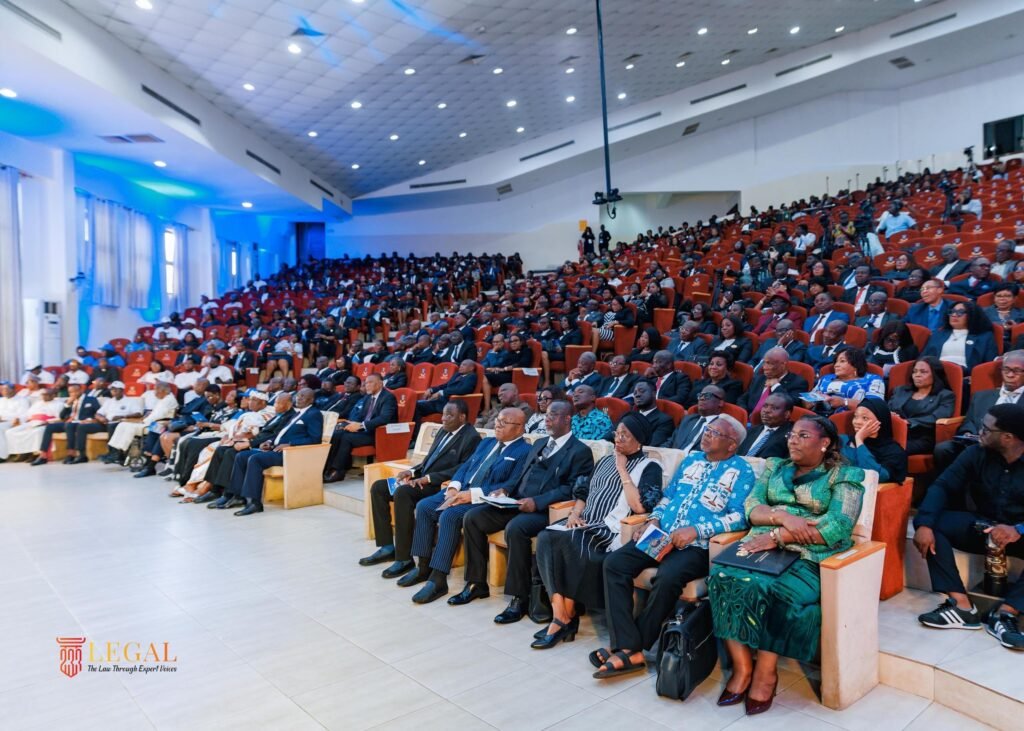

Your Excellency the President of the Republic, Honourable Representatives of Government, Chief Justice and Justices of the Supreme The Court, Esteemed Colleagues,
Distinguished Members of the Bench and the Bar,
Invited Guests,
Ladies and Gentlemen,
It is both a profound honour and a solemn privilege to address this distinguished gathering on the occasion of the sesquicentennial anniversary of Ghana’s Supreme Court. I extend my deepest respect to the Chief Justice and the Honourable Justices of the Supreme Court, whose stewardship continues to uphold the dignity, integrity, and authority of this noble institution. I also respectfully acknowledge the presence of His Excellency the President and representatives of Government, whose commitment to constitutional governance reinforces the foundational principles upon which our Republic stands.
I further recognise the invaluable contributions of members of the Bench and the Bar, whose collective efforts sustain the administration of justice and enrich the development of our legal system. To our distinguished guests and partners in justice, your presence here today reflects a shared commitment to the rule of law and the enduring ideals of fairness and accountability.
This occasion marks not merely the passage of time, but a significant milestone in the history of justice in Ghana. One hundred and fifty years of the Supreme Court represents a legacy of continuity, resilience, and institutional evolution. It is a testament to the enduring strength of the rule of law, the preservation of constitutional order, and the unwavering pursuit of justice across generations. Between these years the country has experienced the stewardship of twenty-eight (28) Chief Justices: From Chalmers in 1876 to Baffoe-Bonnie 2026. Out of this number, twelve (12) were colonial judges and the remaining sixteen (16) Ghanaian; Sir Arku Korsah, being the first Ghanaian Chief Justice from 1956 to 1963.
The Supreme Court is the apex court in Ghana’s hierarchy of courts. The eminent professor of law Emeritus and renowned jurist Samuel Kofi Date-Bah, described the Supreme Court as a “fascinating court” in his book; ‘REFLECTIONS ON THE SUPREME COURT OF GHANA”. Why the description? According to the learned professor, author and jurist, our Supreme Court, when compared to other supreme courts in other jurisdictions, has no equal when it comes to the variety of jurisdictions it exercises and the automaticity of access to it in majority of cases. Maybe the only exception in terms of multiplicity of jurisdictions and ease of access to the court is the Supreme Court of India, which M. P. Jain in his book ‘INDIAN CONSTITUTIONAL LAW, 5th edition, described as the most powerful apex court in the world.
Our Supreme Court’s several types of jurisdiction include: Original jurisdiction in all matters relating to the enforcement or interpretation of the Constitution as provided under article 130 of the Constitution; appellate jurisdiction (Criminal and Civil, including appeals from treason trials and the judicial committee of the National House of Chiefs) – article 131; the review jurisdiction article 133; supervisory jurisdiction article 132; jurisdiction over Presidential Election Petitions, etc. Aside of its several or varied jurisdiction, our Supreme Court has the general authority to develop Ghanaian case law by exercising its freedom to depart from its own previous decisions, when it appears to it right to do so article 129(3), etc. According to statistics obtained from the registry of the Supreme Court, between the years 2020 and 2025, inclusive 2025, the total number of cases filed and registered for hearing before the Supreme Court were two thousand, two hundred and twelve (2,212). These were made up of writs invoking the original jurisdiction of the Court, which were 138; Criminal Appeals 41; Civil Appeals 443; Prerogative writs – 536; Review applications -118: Referrals from other courts – 6 and other motions-1,052. In 2025 alone, cases filed before the court for hearing were 31-writs; 4-criminal appeals; 451 civil appeals; 102 – prerogative writs; 18 Review applications; 2 Referrals and 198 other motions. How did the Court come this far? How long and rough has been this journey? How did a superior court emerge in the Gold Coast, now Ghana? What relationship did it have with the pre-existing indigenous systems of governance and adjudication? How did legal professionalism develop around it and what has the court come to represent in the constitutional life of the Ghanaian state.
The question is; how many people know that the Supreme Court is the oldest surviving institution of public authority in Ghana? The Supreme Court predates independence by more than eighty years and has endured through colonial rule, late imperial reform, independence, republican experimentation, intermittent military interruptions and democratic restoration. The history of the Supreme Court is not therefore a mere history of a court but part of a longer history of how authority, legality and constitutional order have been organized in this country.
The Supreme Court Ordinance of 1876 (No. 4 of 1876), was a landmark British Colonial Law that established the Supreme Court of Judicature of the Gold Coast, now Ghana. It formalized a colonial legal system based on English Common Law, equitable doctrines and statutes of general application in force as at July 24, 1874. It acted as the foundation for the modern Ghanaian judicial system, enabling the legal profession and formally separating the judiciary. It is significant to note that the Supreme Court did not arrive in the Gold Coast in a vacuum. It came to meet local institutions or neighbours already playing political and judicial roles. It was introduced into a political world already governed by recognized systems of normativity, dispute resolution and public accountability. Chiefs, elders, lineage heads and authorities, asafo groups and community leaders exercised jurisdiction long before the arrival of the colonial courts. The governance system was part of a functioning political order with its own principles of legitimacy, sanction and social regulation. The received colonial law or regime, therefore, did not introduce legality into an otherwise unregulated social field. It superimposed a new legal authority or hierarchy upon existing structures of governance, thus establishing a dual legal system: on one side stood the superior courts governed by English law, English procedure and colonial legal doctrine; On the other side stood native tribunals and customary forums, where indigenous law continued to function under colonial regulation.
The establishment of the Supreme Court in 1876 also contributed to the gradual reqularization of legal practice, it created clearer procedures of admission and helped stabilize the institutional environment within which a recognizable legal profession could develop. One of the great landmarks in this history was the rise of John Mensah Sarba of Anomabo as the first native Gold Coast professionally qualified to practice law before the Supreme Court.
Through both advocacy and scholarship, Sarbah mounted a formidable defence of African customary institutions against simplifications and encroachments of colonial jurisprudence He was followed by figures of equal significance including Kofi Assam. Charles James innerman, Thomas Hutton-Mills, J. E. Casely-Hayford, Akuffo-Addo (father not son), J. B. Danquah etc. These were not merely practitioners of the law in the narrow sense, They were members of an emergent African intelligentsia for who law provided both a professional vocation and a conceptual vocabulary through which to think about sovereignty, rights, custom, authority and public order.
Independence in 1957 transformed the constitutional position of the Supreme Court The Court ceased to be merely an instrument of imperial administration and became the apex court or judicial organ of sovereign Ghana with a Ghanaian as a Chief Justice. This was more than a change of constitutional symbolism. From 1960 when Ghana first became a republic and having passed through four (4) republican constitutions; 1969, 1979 and 1992, the Supreme Court has assumed the functions associated with a modern constitutional tribunal. It is required to interpret constitutional texts, adjudicate politically sensitive disputes, delimit executive and legislative power and pronounce upon the legal rights and status of citizens and institutions. Today, we gather not only to commemorate this remarkable journey, but also to reflect on its meaning and to reaffirm our collective responsibility to sustain and strengthen this vital institution for the future.
Introduction
This address is intended to serve three interrelated purposes.
First, it offers a moment of reflection, inviting us to look back with clarity and gratitude at the journey of the Supreme Court over the past one hundred and fifty years.
Second, it is an occasion for celebration, recognising the enduring contributions of the Court to the development of Ghana’s legal system and democratic governance.
Third, and perhaps most importantly, it is an opportunity for forward thinking, to consider how this esteemed institution can continue to evolve in response to the demands of a changing society while remaining anchored in the principles of justice and the rule of law.
The Supreme Court occupies a central and indispensable place in Ghana’s democratic architecture. As the final arbiter of justice and the ultimate interpreter of the Constitution, it serves as the guardian of the rule of law and the protector of fundamental rights and freedoms. Its decisions shape the contours of governance, define the limits of power, and provide the framework within which public institutions operate. In moments of national uncertainty or contestation, the Court stands as a stabilising force, offering lawful and peaceful resolution grounded in constitutional principles.
In reflecting on this important milestone, it is useful to frame our discourse around three interrelated pillars: the past, the present, and the future. The past calls us to honour the legacy of those who built and sustained the institution through periods of transformation and challenge. The present invites us to recognise and celebrate the achievements, strengths, and relevance of the Court in contemporary Ghana. The future challenges us to think critically and constructively about the role of the Supreme Court in an evolving legal and societal landscape, and to define the path that will ensure its continued credibility, independence, and effectiveness for generations to come.
Honouring the Past
In reflecting on the past, we are reminded that the story of Ghana’s Supreme Court is deeply intertwined with the broader evolution of the nation’s legal and political history. From its origins within the colonial judicial system, through the transition to independence, and into the era of constitutional democracy, the Court has undergone significant transformation while maintaining its central role as an arbiter of
justice. Each phase of this journey has contributed to shaping an institution that reflects both historical continuity and progressive development in the administration of law.
The contributions of past judges stand as a testament to the intellectual depth, integrity, and courage that have defined the Court over the decades. Through their decisions, they have developed and enriched Ghanaian jurisprudence, laying down legal principles that continue to guide contemporary judicial reasoning. More importantly, in moments of national difficulty and uncertainty, they upheld the rule of law with firmness and independence, ensuring that justice prevailed even when circumstances were challenging. Their work not only resolved disputes but also reinforced the authority of the Constitution and the sanctity of legal order.
The resilience of the Supreme Court as an institution is particularly noteworthy. It has navigated periods of political transition, constitutional change, and national uncertainty, often serving as a stabilising force within the governance framework. Despite these challenges, the Court has remained committed to its mandate, adapting to changing legal and societal contexts while preserving its core values. This resilience has been critical in sustaining public confidence and maintaining the continuity of justice across generations.
The legacy of this rich history is evident in the strong foundations of constitutional governance and the well-established legal doctrines that underpin Ghana’s judicial system today. The traditions of fairness, independence, and respect for due process that were cultivated over time continue to define the character of the Court. As we honour the past, we do so not only in recognition of what has been achieved, but also with an appreciation of the enduring principles that must guide the Court into the future.
Colebrating the Present
In celebrating the present, we acknowledge a Supreme Court that continues to stand at the very heart of Ghana’s constitutional democracy. Today, the Court performs its role as the guardian of the Constitution with clarity and authority, ensuring that all actions of the State are subject to the supreme law of the land. As the final arbiter of justice, it provides definitive interpretation of legal and constitutional questions, thereby shaping governance, protecting rights, and maintaining the delicate balance among the arms of government. [Note the hullabaloo that arose out of the birth certificate case)
The achievements of the Court in recent years are both significant and commendable. It has demonstrated its capacity to handle complex constitutional and electoral disputes with professionalism and composure, providing lawful avenues for the resolution of highly sensitive national issues. (Reference the 2012 and 2020 election disputes and the hullaballoos they generated the acrimonies, insults, castigations and serious allegations made against the court on both occasions). – Even with all that the country did not burn. The Court stood firm. In doing so, the Court has reinforced democratic stability and contributed to the peaceful management of political contestation. Its role in strengthening the rule of law and promoting constitutionalism rernains central to Ghana’s reputation as a stable and democratic state.
Equally important is the high level of professionalism and independence that characterizes the present Bench. The integrity of the Justices, their commitment to Impartiality, and the depth of legal reasoning evident in their decisions have enhanced the credibility of the Court. There has also been a notable growth in legal scholarship and judicial competence, reflecting both the evolution of legal education and the increasing complexity of cases brought before the Court.
The present period has also witnessed Important improvements in judicial administration. Ongoing reforms aimed at enhancing efficiency, transparency, and access. to justice has strengthened the overall performance of the Court. The gradual integration of technology into judicial processes, including case management and record keeping, has contributed to improving the speed and reliability of judicial proceedings. These developments signal a judiciary that is responsive to modern demands while remaining grounded in its core principles.
Ultimately, the strength of the Supreme Court today is measured not only by its institutional capacity but also by the public trust it commands. Legitimacy and credibility are indispensable to the effective functioning of the Court. The confidence of citizens or the fairness independence, and integrity of judicial processes is essential to sustaining the rule of law. As we celebrate the present, we recognise that this trust is both a valuable asset and a solemn responsibility that must be continuously nurtured and protected.
Defining the Future
As we turn our gaze to the future, we are confronted with a rapidly evolving legal and societal landscape that presents both challenges and opportunities for the Supreme Court. The increasing influence of technology the forces of globalisation, and the growing complexity of legal disputes require a that is not only grounded in tradition but also responsive, adaptive, and forward looking. Issues such as digital governance, cross border transactions, environmental sustainability, and emerging rights frameworks will demand deeper judicial engagement and more innovative approaches to legal interpretation [Note! LGBTQ+++]
In this context, one of the foremost strategic priorities must be judicial innovation. The future of the Court will depend in part on its ability to harness technology to enhance efficiency, transparency, and accessibility. The development of digital courts and e-justice systems offers significant potential to streamline case management, reduce delays, and expand access to justice, particularly for citizens who may otherwise face barriers in engaging with the legal system. Embracing these innovations must, however, be done with careful attention to fairness, security, and due process.
Equally important is the need for jurisprudential leadership in emerging areas of law. The Court will increasingly be called upon to interpret and shape legal principles in domains such as environmental governance, maritime law. digital rights, and economic regulation. In doing so, it must draw on both domestic constitutional values and evolving international legal standards, ensuring that Ghana’s jurisprudence remains relevant, progressive, and responsive to contemporary realities.
At the same time, the independence of the judiciary must remain sacrosanct, Judicial autonomy is the bedrock upon which the legitimacy of the Court rests, and it must be protected from all forms of undue influence. This requires not only constitutional safeguards but also a sustained commitment to ethical conduct, accountability, and institutional integrity within the judiciary itself.
Another critical priority is the expansion of access to justice. The Court must continue to promote inclusiveness and efficiency, ensuring that justice is not only available but also accessible to all segments of society. This involves addressing barriers related to cost, distance, and procedural complexity, and strengthening mechanisms that bring justice closer to the people.
Closely linked to this is the imperative of maintaining and enhancing public confidence. Transparency in judicial processes, clarity in communication, and openness in institutional operations are essential in reinforcing trust in the Court. In an era of heightened public scrutiny, the judiciary must actively engage with the public while preserving its independence and impartiality.
Finally, the future of the Supreme Court depends on sustained investment in capacity building. The development of the next generation of judges and legal practitioners is critical to the long term strength of the institution. Continuous training, mentorship, and exposure to emerging areas of law will ensure that the judiciary remains competent, resilient, and prepared to meet future challenges.
In defining the future, therefore, the task before us is clear: to build on the strong foundations of the past and present, while embracing innovation, strengthening institutions, and upholding the enduring principles of justice, Independence, and the rule of law.
Reflections on Institutional Responsibility
In reflecting on institutional responsibility, it is Imperative to recognise the central role of the judiciary in sustaining democratic governance. The judiciary serves not merely as an interpreter of the law, but as a guardian of constitutional order, ensuring that power is exercised within legally defined limits. In a democratic state, the courts provide a critical check on the actions of the executive and legislative branches,
safeguarding the rights and freedoms of citizens and reinforcing the principle that no Individual or institution is above the law. The strength of a democracy is, in many respects, measured by the independence, integrity, and effectiveness of its judiciary.
At the same time, the judiciary operates within a broader societal context and must continually navigate the delicate balance between the strict application of legal principles and the evolving realities of society. While the Court must remain faithful to the Constitution and the rule of law, it must also be attuned to the social, economic, and cultural dimensions of the issues brought before it. This balance does not imply compromise of legal standards, but rather a thoughtful and context sensitive interpretation of the law that ensures justice is both principled and relevant. In this way, the judiciary contributes not only to legal certainty but also to social cohesion and national development.
Central to this institutional responsibility is the ethical duty of judges. The authority of the judiciary ultimately rests on public confidence, and that confidence is sustained by the integrity, impartiality, and accountability of those who serve on the Bench. It is said that justice depends more, not on the type of law passed, but on the quality of the judge who interprets or applies that law. Judges are called upon to exercise their functions with independence of mind, free from personal interest, external pressure, or partisan influence. They must demonstrate fairness in their conduct, diligence in their work, and humility in the exercise of power. Ethical responsibility is not an abstract ideal; it is a daily commitment that defines the character of the judiciary and ensures that justice is administered with credibility and respect.
In sum, the institutional responsibility of the judiciary is both profound and enduring. It requires a steadfast commitment to democratic principles, a careful balance between law and societal realities, and an unwavering adherence to ethical standards. These responsibilities are not optional; they are the very foundation upon which the legitimacy and effectiveness of the judiciary depend.
Conclusion
As we draw this reflection to a close, we are reminded that the legacy of Ghana’s Supreme Court is not merely a record of years, but a living testament to the enduring power of justice, constitutionalism, and the rule of law. For one hundred and fifty years (31st March 1876 – 30th March 2026), this Court has stood as a guardian of order in moments of uncertainty, a voice of reason in times of contestation, and a sanctuary of justice for the ordinary citizen. As the eminent jurist Lord Denning once observed, “Justice is rooted in confidence, and confidence is destroyed when right-minded people go away thinking: the judge was biased.” That confidence, painstakingly built over generations, remains the most valuable asset of this institution.
This occasion, therefore, is not only a celebration; it is also a call to duty. A call to preserve the sacred values that define the judiciary: justice without fear or favour, integrity without compromise, and independence without exception. Alexander Hamilton also reminded us that, “The judiciary… has no influence over either the sword or the purse.. It may truly be said to have neither force nor will, but merely judgment.” And yet, it is precisely that judgment, impartial and principled, that sustains the very fabric of our democracy. Note! (The two election petitions of 2012 and 2020- Notwithstanding the political differences and the insults and acrimonies that emerged, Ghana did not burn. The people accepted the JUDGMENTS).
We must therefore ask ourselves: What shall history say of us? That we inherited a strong institution and preserved it? Or that we allowed its foundations to weaken under the pressures of time and circumstance? The answer lies in our collective resolve. The past has given us a legacy. The present has entrusted us with responsibility. The future demands our vision. As we honour the past, we remember those who stood firm when it was difficult to do so. As we celebrate the present, we recognise a Court that continues to uphold the Constitution with courage and clarity. And as we define the future, we must commit to building a judiciary that is not only respected, but also responsive; not only authoritative, but also accessible; not only independent, but also trusted.
Let us therefore move forward with purpose and conviction. Let us strengthen what has
been built, refine what must be improved, and boldly embrace what lies ahead, for in the words of Martin Luther King Jr.. “The arc of the moral universe is long, but it bends toward justice.” It is our solemn duty to ensure that this Court remains one of the instruments through which that arc continues to bend in the right direction – JUSTICE.
May the Supreme Court of Ghana continue to stand as a beacon of justice, a guardian of the Constitution, and a symbol of hope for all who seek fairness under the law. I wish all of us “HAPPY 150TH ANNIVERSARY CELEBRATION”
Thanks for your audience
Credit: Judicial Service