

April 6, 2025
“All the world’s a stage,
And all the men and women merely players;
They have their exits and their entrances,
And one man in his time plays many parts…”
— William Shakespeare
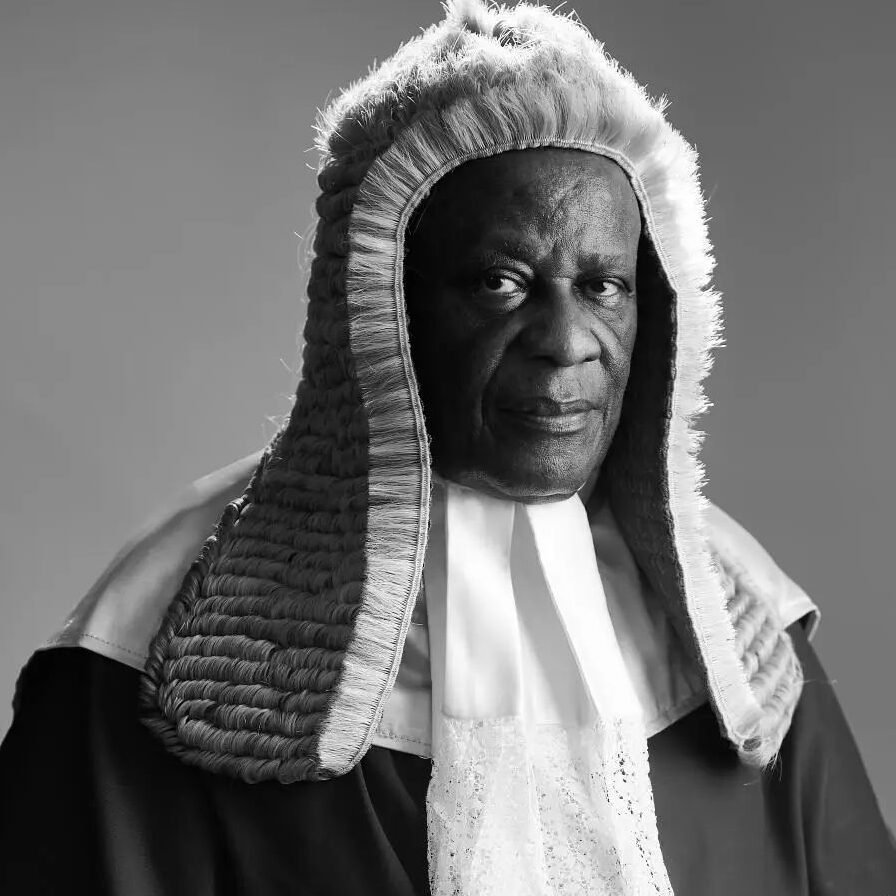
So too did Justice Nasiru Sulemana Gbadegbe enact his distinguished role upon the grand stage of Ghana’s legal and judicial landscape.
Born on 8th December 1950 in the Volta Region of Ghana, Justice Gbadegbe pursued his legal studies at the University of Ghana, graduating in 1973, and was called to the Bar in 1975 after obtaining his qualifying certificate from the Ghana School of Law. His legal Odyssey commenced in 1989 as a Justice of the High Court- a post he occupied with honor for a decade- before his elevation to the court of appeal in 1999. Ultimately his exemplary service was crowned by his appointment to the Supreme Court in 2009, where he remained a pillar of the bench served until his retirement in December 2020, marking an illustrious 31-year tenure.
Justice Gbadegbe’s exit from the Supreme Court was marked by a memorable valedictory judgment in the case of David Apasera & 42 Ors. v. The Attorney General & Anor [2020] GHASC 73. In that landmark judgement, the Supreme Court considered the constitutionality or otherwise of the recommendation of the Chinery Hesse Committee for the payments of pension to former Members of Parliament. Through a careful exegesis of Articles 71(3), 98(1), 114, and 295 of the 1992 Constitution, he persuasively maintained that the Constitution’s explicit reference to “gratuity” for former MPs—omitting any mention of “pension”—effectively precluded the presumption of such payments. His analytical distinction between Article 114(1) and analogous provisions for other Article 71 officeholders, including the Speaker of Parliament and Justices of the Superior Courts, underscored his commitment to constitutional rigour.
He further contrasted the specific provision of Article 114(1) with those relating to other Article 71 officeholders such as the Speaker of Parliament and Justices of the Superior Courts where pensions are explicitly granted. Justice Gbadegbe’s contribution to the bench however extended far beyond this valedictory opinion.
In Sumaila Bielbiel v. Adamu Daramani & Ors. [(2011) JELR 68533 (SC)], he advocated for a broad interpretation of the Supreme Court’s original jurisdiction under Articles 2(1) and 130(1), stressing the Court’s vital role in safeguarding the Constitution against both legislative and executive breaches, even where the questions presented to the Apex Court appeared to be factual in nature. He powerfully articulated the following words:

“The jurisdiction conferred on us by articles 2(1) and 130(1) is to make pronouncements that would contribute to making our country not only a democracy but one governed by law, a country in which the rights of citizens are respected. I ask myself whether the invitation urged on us by the defendant seeks to achieve the valuable goal that the makers of the constitution placed on us to enforce the provisions of the Constitution, and I have unhesitatingly come to the view that it does not. In my thinking, it is unreasonable to say that whenever a particular statute violates the constitution, it is our duty to adhere to the constitution by disregarding the statute and yet whenever acts of constitutional officeholders which are, to be good, subject to certain limitations and restraints expressed sometimes as qualifications are breached because these acts do not involve issues of interpretation, we should decline to invalidate them. This would result in absurd consequences and have the effect not of upholding the constitution but undermining it. Accordingly, I have great difficulty in acceding to the invitation urged on us to deny jurisdiction in the matter herein. In my opinion, the action herein is properly before us.”
Throughout his distinguished judicial career, Justice Gbadegbe epitomised the quiet strength and steadfast integrity of the law. As he takes his final bow, the stage is left resonant with the echoes of his judicious legacy—a legacy that shall forever enrich Ghana’s rule of law.
Our deepest condolences are extended to his family, loved ones, and all who were privileged to witness his noble contributions. May they find solace in the knowledge that he served his nation with distinction and has bequeathed an enduring mark upon its legal heritage
Nana Nti Ofori-Debrah, a legal practitioner contributed to this article.