

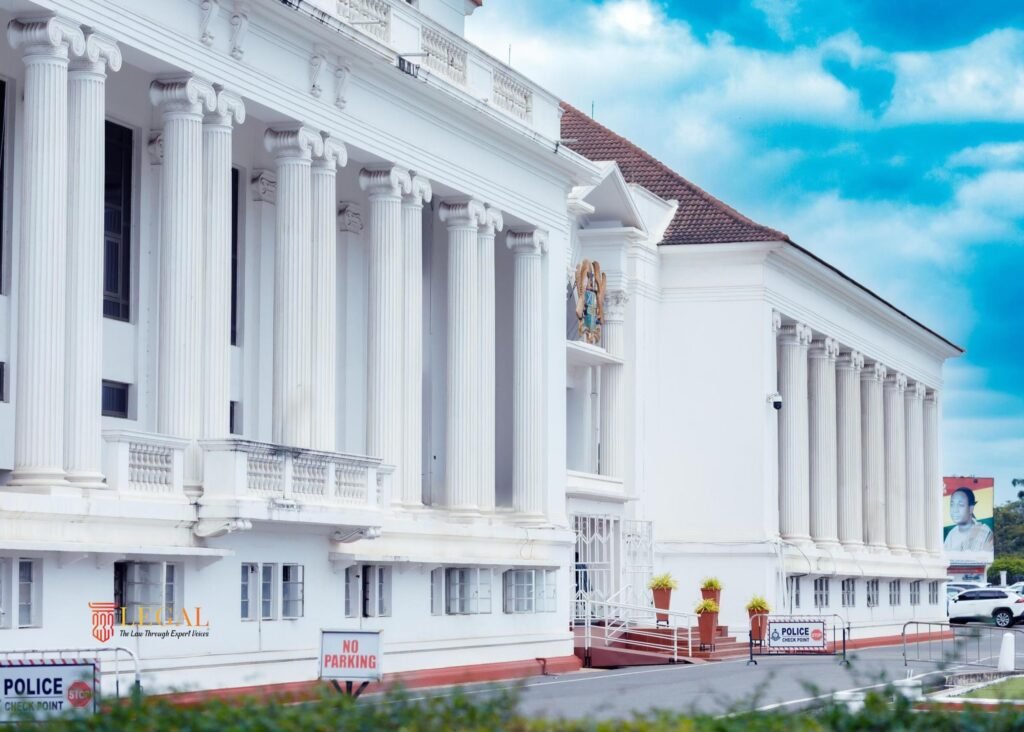


Supreme Court of Ghana | (1992) JELR 68120 (SC) | Judgment delivered on July 29, 1992
Introduction:
Can a coroner lawfully hold an inquest where the cause of death has already been medically certified?
In Ghana, a coroner (usually a District Magistrate) investigates sudden or unexplained deaths by conducting a formal inquiry known as the coroner’s inquest. Through this formal inquiry, the coroner determines how the deceased came by his or her death. Although the process is not a criminal trial, its findings may carry significant legal and practical consequences.
This case examined the limits of a coroner’s jurisdiction under the Coroners Act, 1960 (Act 18), the distinction between an “unknown” and an “undetermined” cause of death, and whether the High Court could quash proceedings that, in substance, amounted to a murder trial.
Facts:
Emmanuel Atta Ampomah, a hypertensive and diabetic patient for over two decades, was admitted to the Korle-Bu Teaching Hospital on 29 January 1990 and died the same day. Because he had been in hospital for less than 24 hours, the hospital’s standard procedure required an autopsy to determine the cause of death.
Dr. William Minnow Simmons, a pathologist trainee, conducted a partial post-mortem on the skull and found “bilateral intracerebral haemorrhage with subarachnoid extension,” consistent with hypertensive heart disease. He recorded the cause of death as cerebrovascular accident.
Kwabena Peprah, a brother of the deceased who had been abroad, returned home suspecting foul play. He pressured a second post-mortem to be conducted by Dr. Felix Dodu, a consultant forensic pathologist. Dr. Dodu could not examine the brain (it had been disposed of after the first examination, which was standard practice), found no marks of violence, and detected no common poison. Unable to examine the brain, he concluded that “the immediate cause of death is undetermined.”
The police investigated the matter at Peprah’s instigation, took statements from various persons, and ultimately cleared the widow, Flora Ampomah, of any suspicion. The body was released for burial. News of her exoneration was published in a national newspaper on 31 March 1990 – the very day her husband was buried.
Despite the police closure, Peprah complained to the Inspector-General of Police, who caused the docket to be sent to the Accra District Magistrate (acting as coroner). On 10 May 1992, the coroner convened an inquest, stating he had “carefully examined the docket” and concluded “the inquest should be held.” The widow was subpoenaed and compelled to testify, with Kwabena Peprah openly described in the proceedings as the “applicant” – the originator of the inquest.
Flora Ampomah applied to the High Court for orders of certiorari (to quash the proceedings) and prohibition (to prevent further hearing). The High Court granted the orders. The Republic appealed to the Court of Appeal, which reversed the decision. The widow then appealed to the Supreme Court.
Issues for Determination:
- Whether the coroner had jurisdiction under section 5(1) of the Coroners Act 1960 (Act 18) to hold an inquest where the cause of death was already known from the available post-mortem reports.
- Whether the coroner’s power to hold an inquest is discretionary or mandatory, and whether it is subject to review by the High Court.
- Whether the High Court judge usurped the coroner’s jurisdiction by calling Dr. Simmons to clarify his post-mortem report.
- Whether certiorari and prohibition were available remedies to quash the inquest proceedings.
The Court’s Holding:
The Supreme Court allowed the appeal unanimously, set aside the Court of Appeal’s decision, and restored the High Court’s orders of certiorari and prohibition. The Court held that:
- The cause of death was known. When the two post-mortem reports were read together, it was clear that the deceased had died of cerebrovascular accident. Dr. Dodu’s use of the word “undetermined” merely reflected that he personally could not verify the cause because the brain had been removed before his examination – it did not mean the cause was “unknown” within the meaning of section 5(1)(b) of Act 18. The coroner therefore lacked any jurisdictional basis to hold the inquest.
- “Unknown deaths” and “undetermined deaths” are not the same. “Unknown death” means one has no clues at all. “Undetermined deaths” on the other hand means one has choices but cannot settle on one. The Coroners Act requires the former (unknown deaths); Dr. Dodu’s finding was the latter(undetermined deaths). These two expressions cannot be conflated to invoke coroner jurisdiction.
- The coroner’s duty under section 5 is mandatory, not discretionary. The word “shall” in section 5 creates a mandatory obligation – but only once the preconditions exist. Where those preconditions are absent, the coroner has no authority to act. The Court of Appeal wrongly treated the decision to hold an inquest as a matter of pure discretion shielded from review.
- The High Court did not usurp the coroner’s jurisdiction. Calling Dr. Simmons to clarify his report was a proper exercise of the High Court’s supervisory function to determine whether the preliminary jurisdictional facts existed. A court of limited jurisdiction cannot clothe itself with authority by wrongly deciding a collateral jurisdictional question – such a question is always open to review by a superior court.
- The coroner acted on a private solicitation, not statutory duty. The coroner clearly held the inquest because Kwabena Peprah requested it – not because he had reasonably suspected any of the statutory conditions under section 5(1). No member of the public has a right to apply for a coroner’s inquest. The right is vested exclusively in the coroner, subject to the existence of statutory preconditions.
- The inquest was a nullity. The magistrate who commenced the inquest was on “relief duty” and was not duly appointed to that magisterial district. Under section 1(1) of Act 18, only a magistrate appointed to a district is its coroner. The entire inquest proceedings were therefore void.
Implication of the Decision:
This decision authoritatively defines the jurisdictional limits of a coroner’s powers in Ghana. A coroner’s inquest is not a routine inquiry to be convened whenever a family member raises suspicion. It is a solemn proceeding reserved for cases where the cause of death is genuinely unknown, or where the death is violent, unnatural, or occurred in prescribed circumstances. Where none of those statutory conditions is satisfied, the coroner has no authority to sit. The decision also confirms that the High Court may review a coroner’s preliminary jurisdictional finding on an application for certiorari and prohibition – this supervisory function cannot be shut out by characterising the coroner’s decision as “discretionary.”
Significant Quote:
“Coroners’ inquests are no pantomime shows. They are not comic plays. They are not tragic operas to be listened to and watched by an audience. They are solemn and mournful proceedings to determine how a human being came by his death. These proceedings cause pain and sorrow to relatives and it seems that inquests should not be held unless they were necessary and desirable. Inquests should not be regarded as routine matters in all cases otherwise coroners would be likened to automatons and robots.”
- Archer CJ
Commentary and Insight:
This decision is a clear application of the jurisdictional fact principle in Ghanaian public law. Under section 5(1) of the Coroners Act, 1960 (Act 18), a coroner’s duty to hold an inquest arises only where there is reasonable cause to suspect that the deceased died:
- a violent death;
- an unnatural death;
- a death of which the cause is unknown;
- while detained in a prison, lock-up, psychiatric hospital or public institution (other than a hospital); or
- in circumstances making an inquiry necessary or desirable.
These statutory conditions are jurisdictional facts. They must objectively exist before the power to hold an inquest arises. If they do not, the coroner lacks authority, and any proceedings conducted are void.
The Supreme Court further affirmed that the existence of these jurisdictional facts is reviewable by the High Court. An inferior tribunal cannot conclusively determine the scope of its own jurisdiction.
For the general public, the case clarifies that an inquest cannot be convened merely because a family member raises suspicion. The law requires specific, legally defined conditions. This ensures that coronial proceedings remain confined to their statutory purpose and are not invoked without proper legal foundation.